Substance use disorders affect millions of Americans every year.
According to SAMHSA’s national survey, most people who need treatment don’t get it.
Outpatient care lets you get help while you live at home.
Drugs or alcohol may have started running your days, or you may be watching it happen to someone you love. If so, you’re probably tired, worried, and unsure where to start. Compassion Recovery Centers offers outpatient rehab in Orange County that gives you real structure and clinical care while you keep living at home.
Our drug rehab in Laguna Hills is at 23141 Moulton Pkwy, Suite 207. You come in for scheduled treatment, then go home and sleep in your own bed. That means you can keep up with work, school, or family while you focus on getting better.
Addiction is a health condition, not a moral failing. It changes how the brain handles reward, stress, and self-control, which is why willpower alone so rarely works. Treatment gives you tools, support, and accountability. It also looks at what’s driving the use, not just the use itself.
Outpatient care is usually a good fit if you’re medically stable, have a safe place to live, and want treatment that works around your daily life. It can also be your next step after detox or a residential stay. If you need around-the-clock care first, our team will tell you honestly.
If you’re worried about a teenager, we also offer teen mental health treatment and dual diagnosis programs for teens ages 12 to 17.
Compassion Recovery Centers is accredited by The Joint Commission and licensed by the California Department of Health Care Services (DHCS). We are in network with many insurance plans, including Medicare. We work with plans from Aetna, Anthem, BCBS of California, Cigna, United Healthcare, and Tricare, and we verify your benefits for free.
Outpatient drug rehab is a set schedule of therapy sessions, groups, and check-ins with your care team. It starts with a free assessment so we understand your substance use, your physical and mental health, and what’s happening in your life. From there, your plan sets how much care you get each week and which therapies you use.
Your therapy is led by master’s-level therapists who focus on behavioral treatment for substance use disorders. Behavioral treatment means working on the thoughts, habits, and situations that keep the use going, then practicing new ways to respond. The approaches they use include:
Recovery goes better when the rest of your life gets steadier too. Alongside therapy, we help you build habits around nutrition, exercise, and stress management. These are the tools you’ll keep using long after formal treatment ends.
Sleep is often rough in early recovery, and anxiety can spike when you stop using. Tell your care team if either is a struggle so you can work on it together. If depression, anxiety, or trauma is part of what’s going on, our dual diagnosis treatment in Orange County treats your mental health and substance use at the same time.
Addiction affects everyone close to you. Family therapy gives your loved ones a place to understand what’s happening, repair trust, and learn how to support recovery without losing themselves. You decide how much your family takes part.
Addiction care is organized into levels, from round-the-clock inpatient care down to weekly outpatient therapy. The American Society of Addiction Medicine (ASAM) Criteria help providers match you to the level that fits your needs right now. Your level can change as you get stronger.
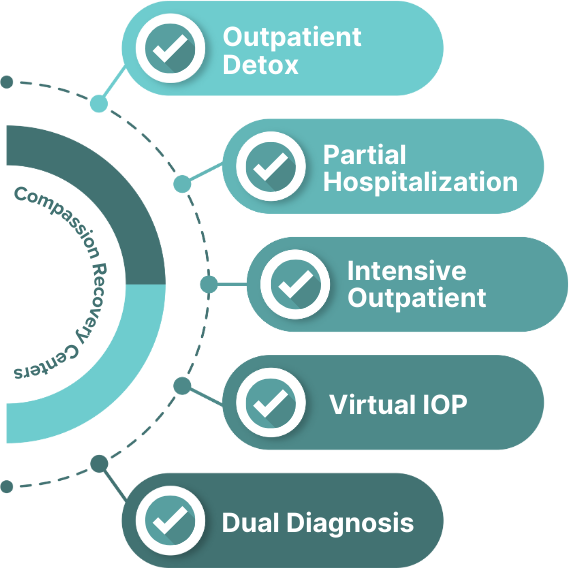
Compassion Recovery Centers offers partial hospitalization, intensive outpatient, outpatient care with ongoing aftercare, and virtual IOP. If your assessment shows you need detox or a higher level of care first, our admissions team will talk with you about next steps.

In-person care takes place at our center in Laguna Hills. Your week depends on your level of care. Under the ASAM Criteria, partial hospitalization generally means 20 or more hours of treatment a week. Intensive outpatient for adults generally means at least nine hours a week, spread across a few days. Our admissions team can walk you through our current schedule.
A typical treatment day mixes group therapy, skills work, and time with your therapist. You practice what you learn at home, at work, and with family, then bring what happened back to your next session. That back-and-forth is one of the real strengths of outpatient care.
If you can’t step away from work, ask about our evening IOP options. Evening care lets you keep your income and routine while you get treatment.
If getting to Laguna Hills is hard, you may be able to do your care through our virtual IOP. It offers live group and one-on-one therapy by secure video, with morning and evening groups for adults across California. Our team can help you decide whether in-person or virtual care makes more sense for you.
Withdrawal from some substances, especially alcohol, benzodiazepines, and opioids, can be dangerous or very hard to get through alone. Don’t try to quit these suddenly on your own. Your assessment helps show whether you need medical support for withdrawal before outpatient care. Our admissions team will talk through your options with you.
PHP, sometimes called day treatment, is the most structured level of care we offer. You spend much of the day in treatment, several days a week, then go home at night. It often fits right after detox or residential care, or when weekly therapy isn’t enough. See how our partial hospitalization program works.
IOP gives you several hours of treatment a few days a week. It works well for people stepping down from PHP. It also suits people who need more than weekly therapy but want to keep working or going to school. Our intensive outpatient program in Orange County page explains how it works.
Standard outpatient care means fewer hours each week, usually individual and group sessions that help you protect your progress. It focuses on handling real-life stress without using. Aftercare is part of our standard treatment, so you have a steady place to keep checking in after more intensive care ends. Learn more about our outpatient program.


Every substance affects the body and brain a little differently. Your plan reflects what you’ve been using and how. Here’s how our Orange County drug rehab approaches the most common ones.
Opioid addiction can start with a prescription after an injury or surgery. It can also start with street drugs like heroin. Fentanyl is now mixed into many street drugs and fake pills, so any use carries a much higher risk of overdose. SAMHSA and NIDA describe medications for opioid use disorder, combined with therapy, as a standard part of care. If you want to explore medication, raise it at your assessment. Your team will talk it through with you. Keep naloxone (Narcan) on hand, and make sure your family knows where it is.
Stimulants include meth, cocaine, and ADHD medications used other than as prescribed. No medication is FDA-approved to treat stimulant addiction. That means behavioral treatment does most of the work. NIDA points to approaches like CBT and contingency management, a method that rewards drug-free milestones with small incentives. Our therapists use CBT to help you ride out cravings and the low mood that often follows when you stop.
Benzodiazepines such as Xanax, Klonopin, Valium, and Ativan are often prescribed for anxiety or sleep. After regular use, stopping suddenly can cause serious withdrawal, including seizures. A slow, doctor-guided taper is the safer path, so talk with your prescriber before changing your dose. Therapy then helps with the anxiety or sleep problems that often sit underneath. You can read more about benzodiazepine tapering and support on our blog.
Alcohol is legal and everywhere, which can make a drinking problem easy to hide, even from yourself. If you drink heavily every day, withdrawal can be dangerous, so don’t stop suddenly without medical advice. Our page on alcohol rehab in Orange County explains how we help people who are struggling with drinking.
Plenty of people don’t think of cannabis as addictive, but NIDA recognizes cannabis use disorder as a real condition. Today’s products are often much stronger than in the past. If you can’t cut back, or your use is hurting your work, sleep, or relationships, outpatient therapy can help you change the pattern.
Substance use and mental health problems often show up together. NIMH and SAMHSA both note that conditions like depression, anxiety, PTSD, and bipolar disorder commonly occur alongside addiction. Treating only one usually leaves the other to pull you back. That’s why your assessment looks at both.
If you’re not sure where your use fits, that’s what the assessment is for. Call (877) 414-3007 to talk with our admissions team. It’s free and confidential.
Bring the basics so your care team has an accurate picture from the start:
Because you go home each day, you don’t need to pack a bag. If you have questions about a specific item, our admissions team can help.
There’s no single answer. It depends on your needs and how you respond to care. A common path is to start in PHP, step down to IOP, then continue with outpatient support. NIDA notes that people generally do better when they stay in treatment long enough, often three months or more across all levels of care. Your team reviews your progress and adjusts the plan along the way.
Not from us without your permission. Health privacy laws, including HIPAA and a federal rule called 42 CFR Part 2, give substance use treatment records extra protection. In general, your treatment information can’t be shared with an employer or anyone else without your written consent. There are narrow exceptions, such as a medical emergency. If you need time off, you choose what to share. Virtual sessions take place over secure video.
Inpatient or residential rehab means living at a facility around the clock. It’s usually recommended for people who need medical monitoring, face severe withdrawal, or don’t have a safe place to live. PHP and IOP fit people who are medically stable and can stay safe at home between sessions. Your assessment helps answer this. If you need a higher level of care first, we’ll tell you.
Many health plans cover substance use treatment. The federal Mental Health Parity and Addiction Equity Act and California’s parity law require many plans to cover addiction care on terms similar to other medical care. What you pay depends on your deductible, copays, and whether care is medically necessary. We check your benefits for free and explain your costs before you start.
For some adults, yes. Our virtual IOP offers live group and one-on-one therapy by secure video for adults across California, with morning and evening groups. It can work well if you’re medically stable and have a private, safe place to join sessions. If you need more structure or support than video care can give, your assessment will point you toward in-person care in Laguna Hills instead.
Many people do. IOP and outpatient care take only part of your week, and we offer evening IOP options for people who work during the day. Virtual care can also cut out the drive. PHP takes more of your day, so some people take leave from work for that stretch of treatment.
Detox needs vary a lot from person to person. Your free assessment looks at what you use, how much, and for how long, so we can tell whether you need medical support for withdrawal first. Our admissions team will explain your options and how to move into PHP or IOP when you’re ready.

Cost is one of the biggest worries people have about rehab, and it shouldn’t stay a mystery. Compassion Recovery Centers is in network with most insurance and Medicare plans. These include Aetna, Anthem, Blue Shield of California, Cigna, UnitedHealthcare, Tricare, and Medicare. We verify your benefits for free and tell you what you’d pay before you commit to anything.
Getting started is simple. You call us or fill out the form on this page, and we check your coverage. Then you have a free assessment with our team so we can recommend the level of care that fits. From there, we help you pick a start date and a schedule that works with your life.
You don’t have to have everything figured out before you reach out. Call (877) 414-3007 to talk with our admissions team. It’s free and confidential.
Call us or fill out the form on this page, and we'll check your insurance benefits for free. You'll know what you'd pay before you commit.
Our team talks with you about your substance use, your health, and your life. This helps us recommend the level of care that fits you right now.
Together we pick your level of care, a start date, and a schedule that works with your life. Care happens at our Laguna Hills center, and virtual IOP may be an option.
You meet with master's-level therapists in individual and group sessions. Between sessions, you practice new skills at home, at work, and with family.
Our outpatient care includes ongoing aftercare. You keep a steady place to check in as you step down from more intensive care.
Driving to treatment several times a week isn’t realistic for everyone. Long commutes, kids at home, or a demanding job can make in-person care hard to keep up with. For some adults, virtual drug rehab is a good fit.
Our virtual IOP offers live group and one-on-one therapy by secure video, with morning and evening groups for adults across California. You meet with our master’s-level therapists in real time, not through an app. From a private room at home, you work on the same skills-based therapy you’d get in person.
Virtual care tends to work best if you’re medically stable and have a safe, private place to join sessions. You also need to be able to show up on schedule. It can be a good way to keep your support going if you’re stepping down from more intensive care.
In-person care in Laguna Hills is often the better choice if you’re at risk of serious withdrawal or if the people or setting at home make it hard to stay sober. It also makes sense if you need the structure of our partial hospitalization program. Some people simply find that being in the room with a group helps them stay engaged. Your assessment helps you decide, and you can change formats as your needs change.
If you’re unsure which option fits you or your loved one, call (877) 414-3007 to talk with our admissions team. It’s free and confidential.


We are 100% in Network Provider. Most of our clients pay $0 out of pocket.